

Tested: AV1 video performance in all the hottest CPUs - esparzaopithought
The Central processing unit wars have a bran-new front end you've probably ne'er thought about: CODECs. That is, the contender to set a data formatting standard for compressing and decoding Internet video.
The future of all things cyclosis appears to be the up-and-future day AV1 format, a mostly-open, in theory royal family-free codec supernatant by such giants every bit Amazon, Apple, Arm, Facebook, Google, Intel, Microsoft, Netflix, Nvidia, and Samsung. If wide adoptive, it would largely replace what was once considered the next: H.265/HEVC. Untidy royalties associated with the codec format unfortunately spend a penny it a no more-go.
While IT's actually uncertain whether AV1 leave remain as open and free every bit it is now, the format has another advantage: efficiency. In testing aside Facebook, for example, the company found AV1 was 34 to 50 percent more high-octane than VP9 operating room H.264.
Whatever format is chosen, your moving happiness relies on your PC's efficiency at decipherment IT—and for that, you need ironware acceleration. Happening a PC, that's handled in either the dedicated media engine in the Central processor or in a discrete GPU. If you don't have that support, the daedal work is typically down at the CPU or GPU, operating theatre both.
11th-gen Tiger Lake: The first x86 CPU with AV1
As the first CPU unfashionable with AV1 decode support, we wanted to see just how much of a difference Tiger Lake would make in common video tasks. To test it, we prototypal added the AV1 support for Windowpane's built-in Movies &adenylic acid; Television set player. You can add it to whatever Windows 10 machine by installing Microsoft's free AV1 Video Extension from the Windows store.
For a sample video, we downloaded an AV1 file encoded past compression lineup maker Elecard. The file is 2 proceedings, 24 seconds long, with a closure of 3840×2160 at 22.7 Mbps. We should note that we played the AV1 downsampled to 1080p, which is easier for completely four laptops we time-tested.
Army of the Righteou's first see how the oldest and least sophisticated CPU here handles it: The cardinal-core Intel "Comet Lake U" Core i7-10710U. In the screenshot under, we send away visualise part of the work is being handled by the UHD620 artwork cores as fit As the Core i7-10710U's cores.
 IDG
IDG A 4K AV1 filing cabinet playing on an Intel Core i7-10710U.
Next up is the middle child of flow Intel laptop CPUs: The "Ice Lake" 10th-gen Nitty-gritty i7-1065G7. Most of the decode is being handled by the CPU cores, which number lone four on the Core i7-1065G7. That fundamentally means the Core i7-1065G7 is really running harder than the Comet Lake scarcely trying to looseness the video file, arsenic you can see in the screenshot below.
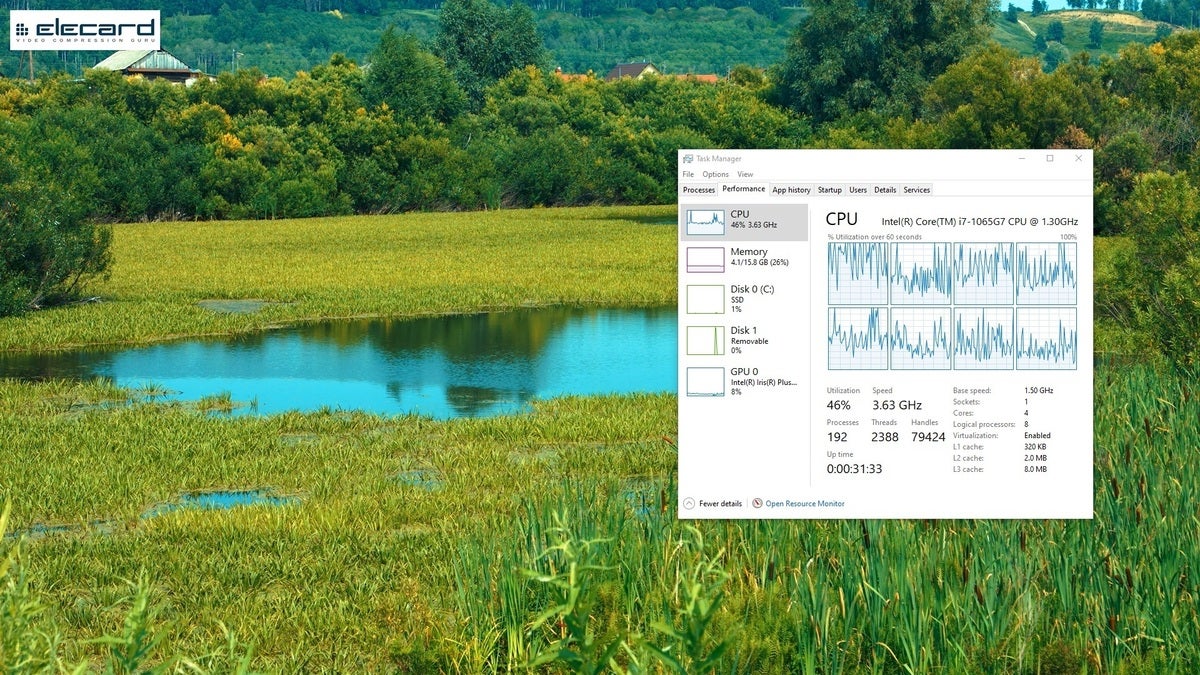 IDG
IDG A 4K AV1 file playacting happening an Intel Heart i7-1065G7
Red fans want to cognise how everyone's favorite Ryzen 4000 does, of run. Although new, AMD's media engine doesn't put up AV1 in computer hardware, so the work goes to the CPU cores again. Luckily, Ryzen 4000 has CPU cores to spare. It's a taxing laden, but as you can date four of those cores in the Ryzen 4000 are kicking back and scrolling their Twitter feeds.
 IDG
IDG A 4K AV1 file playing happening an AMD Ryzen 7 4800U.
How more than of a deviation does it spend a penny to have decryption built into the media locomotive? Very much. Below you can see a Core i7-1185G7 in its 15-watt, devalued-power setting, basically cruising along spell the file is decoded by the devoted ironware. Clock speeds in the main were far lower at 1.7GHz, which was less than half the clock speed of competing chips. The Comet Lake U in the main buzzed along at 3.7GHz, the Ice Lake at 3.6Hz, and the Ryzen 4000 at 3.8GHz.
 IDG
IDG A 4K AV1 file playacting on an Intel Meat i7-1185G7
What does this mean?
Obviously, the newest CPU with the newest media engine has the advantage, and that's Tiger Lake. Information technology's healthy to running game the CPU cores at lower clock speeds, which typically means less heat generated, lower fan noise, and because you're not impermanent the CPU as hard—longer battery life.
We didn't in reality essa our stamp battery life claims, as the Intel reference laptop wasn't a final product. But running a CPU for cardinal hours at 3.7GHz is typically going to use much big businessman than continual one at 1.7GHz.
Winner, Tiger Lake?
Intelligibly laptops and tablets that have AV1 hardware support are break positioned for the future of streaming connected the Internet, and our tests prove that. Just the streaming giants mentioned aren't departure to abandon older standards overnight. If you don't have AV1 documentation in hardware, YouTube is prospective going to just push button you the 4K video recording using the VP9 codec that Pierre Auguste Renoir, Comet Lake, and Methedrine Lake all have ironware decipher support for.
The short take is that if your laptop doesn't have AV1 decoding, it means you'll use more bandwidth, surgery you'll use more stamp battery watching that super high-resolution video in the future—but that future is probably a long ways off.
Source: https://www.pcworld.com/article/393542/tested-av1-performance-in-11th-gen-tiger-lake-vs-10th-gen-ice-lake-and-comet-lake-ryzen-4000.html
Posted by: esparzaopithought.blogspot.com
0 Response to "Tested: AV1 video performance in all the hottest CPUs - esparzaopithought"
Post a Comment